A friend asked me what compost tumbler they should buy. Yes, the tumblers. I looked at these for years and it was almost the choice I made for myself.
Let's proceed.
The one i kept coming back to was the 'Compost Tumbler,' this bad boy, right here.
Reasons?
1. You can get a double one. Capacity is king with tumblers and you will be astonished how little capacity you have, even though the thing looks huge. If you get it, just get the double one. Honest. Get the double.
2. It has a crank. I've also seen a solar or electrical unit that just slowly rotates the thing all the time, but i can't remember where to get it - that would be most excellent to add on.
I've tried the 'roll around' and 'flip with your foot,' 'easy compostin', 'brought to you by the producers of hee-haw' bullshit tumblers. If you enjoy punishing yourself, feeling frustration, and the smell of anaerobic bacteria in the morning - the 'roll-arounds' are the tumblers for you. They're such an olympicly awful pain to roll around, you won't get much tumbling done.
3. The thing looks like the sturdiest one to me. I have no actual knowledge of ever seeing one, it's a gut reaction based solely on looks. Oh, and they'll get you tons of hot chicks if you buy one. That's a lie.
Now.
Forget for a moment that you're going to load mountains of yard waste into something above your waistline, through little doors in the side (yup, there are other roller ones that don't, but this was the one i would have chosen, even knowing the pain of loading it, so it is what it is); that's not insurmountable, and can be part of a balanced fitness program.
What i want to clearly impress upon you is a word of caution about any composter in the tumbler format or any closed plastic format: stuff gets so hot in these, that they turn into a thick muck quickly. If yer not tumblin' with regularity, you will essentially have a big cylindrical colon full of wet, thick, tar-like shit soon. And constipation sets in fast. You will be forced to perform the most giant high-colonic you can summon in your imagination if this occurs. Yum.
Hope that helps and happy rotting!
James
Monday, October 20, 2008


Monday, September 3, 2007
Autumn Tree Planting
You’ve read it lately: “Fall is for Planting.” But can you really plant in the Fall, and why would you want to?
Benefits
In September, the heatwave has ended and it will be easier to keep your new tree moist. Another benefit to Fall planting is price. Some nurseries will lower prices to clear this season’s stock. But these are bargains only to the careful gardener.
What to Watch For
Planting in the Fall is not without risks. As Jeff Iles, Iowa State Extension Horticulturalist, notes in his Community Tree Planting and Care Guide, trees planted in the Fall are more prone to failure than those planted in the Spring. Choose wisely:
How To
Balled & burlapped trees and container-grown trees do well with Fall planting. Jeff’s Tree Planting Guide will give you more specifics, but here’s how to make it work.
With care and caution, you’ll have extra autumn color next year! It's another way to make your yard, your way.
Benefits
In September, the heatwave has ended and it will be easier to keep your new tree moist. Another benefit to Fall planting is price. Some nurseries will lower prices to clear this season’s stock. But these are bargains only to the careful gardener.
What to Watch For
Planting in the Fall is not without risks. As Jeff Iles, Iowa State Extension Horticulturalist, notes in his Community Tree Planting and Care Guide, trees planted in the Fall are more prone to failure than those planted in the Spring. Choose wisely:
- Buy from trusted nurseries.
- Avoid amazing bargains; if it dies, it’s not a bargain (or amazing).
- Know the guarantee. If your tree doesn’t green-up by May, will you still be covered?
- Don’t plant bare-root stock in the Fall. It will be experience unneeded stress and be unlikely to succeed.
How To
Balled & burlapped trees and container-grown trees do well with Fall planting. Jeff’s Tree Planting Guide will give you more specifics, but here’s how to make it work.
- Plan for the mature size of the tree. Most shade trees will spread as much as 30 feet in adulthood. A young sugar maple next to the front door may look charming now, but it will look truly dangerous (and silly) in a matter of years.
- Keep your tree moist until planting and plant as soon as possible, digging a hole two to three times the diameter of the root-ball.
- Do not amend the soil when refilling the hole. Adding topsoil or other amendments creates pockets where water will not penetrate, or cannot drain. It’s best your tree adapts to your soil.
- Keep the root crown of your tree level with the soil as it was in the container or wrap in which it came.
- Mulch around it four to six inches deep with organic mulch – this is true tree love.
- Water your tree in well and keep the soil moist, even checking the moisture through the winter.
With care and caution, you’ll have extra autumn color next year! It's another way to make your yard, your way.
Saturday, July 21, 2007
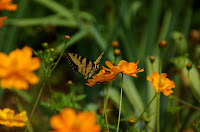
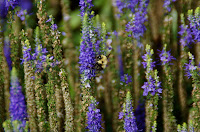
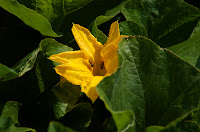
Summer Garden
Typically, the weather's been so awful or I've been so busy that I don't see my gardens for weeks at a time once July and August get going. But this year has been a nice mix of rain at the right time and making time to enjoy. Just sharin'.







Monday, July 16, 2007
Tomato Hornworm
 Ah, the tomato hornworm, ‘Manduca quinquemaculata’ … if you’ve seen one of these 4 inch, fat, green, silken-skinned beauties on your tomatoes, you’ve no doubt had the same deep-seated reaction I have… _barf_.
 While the hornworm does end up making a fairly cute moth, they ravage tomato plants, stripping them overnight sometimes. What's a gardener to do? There are a number of tactics that practiced together can reduce the population.
It’s important to note, in pest management a 50% reduction each year is an aggressive goal. Most problem pests can be reduced over time to a 10% population that is manageable. The following represent a multi-pronged offense that together can help reduce their population.
Icky? Yes. (i got all yicked-out just writing about them.) Picking them off icky-er? *shudder* Definitely. But gardeners who love tomatoes will brave these grodies. Think of them as… dragons of the garden, and you the St. George of Tomatoland.Cultural Practices
Mature worms drop to the soil, burrow about 4 inchesdown, and form a red brown pupal cell. Good tillage has been shown to help break up more than 90% of these in a large infestation, cutting down on the number of eggs that are laid the following year.
An important cultural practice is one of doing nothing… in a specific circumstance. There’s a parasitic braconid wasp, ‘Cotesia,’ that lays its eggs to feed on the horn worm. (The paper wasp 'Polistes' also preys directly on the adult hornworm itself - delicious.)If you should find a hornworm that is covered in little, rice-like cocoons, do not remove this worm or harm it. Its survival (until the wasp larvae have eaten it from the inside out – there’s some poetic satisfaction there, eh?) will ensure the survival of more parasitic wasps, who will hatch in the same season, lay more eggs, devour more hornworms… well you get the picture. Circle-of-life, miracle-of-birth -- all that.
Manual Removal
As icky as it is, hand picking is the most successful control in the home garden. It is unfortunate that they are hard see until there is a lot of destruction. Hornworms are very small when young and at all larval stages will avoid the heat of the day, sticking to the inside of the tomato plant.They’re most easily spotted around dawn and dusk. Picking these guys off and (eesh) squishing them in whatever method you find least nauseating… is your key to success.
Hornworms are in their egg stage for too short a period to pick off or smash as one might with the eggs of other garden pests, usually 5 days or less. The green to white eggs are also very small (1.5 mm) and hard to find.
Biological Controls
Bacterial insecticide containing ‘Bacillus thuringiensis’ or BT (e.g., Dipel, Thuricide) can be applied in the very early stages when the worms are small (always follow label directions, even with 'safer' biological controls like BT).This is a good preventative to use in gardens that experience regular infestations. Apply early in the season before there are any signs of the worm. BT is a bacteria that harms only certain insects like the caterpillars, mosquitos, and others; it has little or no effect on humans, wildlife, pollinators, and most other beneficial insects.
Unfortunatly, BT will also do little to harm the adult worms; treat early!
Chemical Treatment
Hornworms can be controlled with limited success using carbaryl, permethrin, spinosad insecticides. Read the label carefully before using any insecticide.


Or maybe try not to think about it at all. Just squish and get it over with.
Tuesday, July 10, 2007
Japanese Beetle Treatment
These little pests are driving people nuts. They're eating roses, maple leaves, raspberries, daisies, basil ... and they're everywhere in lazy, disgusting swarms. Sometimes there are clouds of them in the morning after they get their first warmth from the sun.
What to do?
Actually, I haven't had much trouble from them this year. They're nearly non-existent in my yard compared to years past. When they made their debut in late June this year (a little early for our area) I was spraying for the dreaded pumpkin vine borer at the time and also sprayed the beetles and the main areas they were occupying with Malathion. While there's little to predict what kind of Japanese beetle season you'll have or what could actually reduce their populations, I'm experiencing a significant reduction from last year. I just can't say why with any certainty.
Others I've talked with have tried the following with some success:
So, what works? Who knows. If you find a method that has been reliable year after year, post a comment - I'm super interested to know.
What to do?
Actually, I haven't had much trouble from them this year. They're nearly non-existent in my yard compared to years past. When they made their debut in late June this year (a little early for our area) I was spraying for the dreaded pumpkin vine borer at the time and also sprayed the beetles and the main areas they were occupying with Malathion. While there's little to predict what kind of Japanese beetle season you'll have or what could actually reduce their populations, I'm experiencing a significant reduction from last year. I just can't say why with any certainty.
Others I've talked with have tried the following with some success:
Putting out Japanese beetle traps
The traps have a pheromone that attract the beetles who are super interested in mating as frequently as possible before their die at the end of the month. You will attract other beetles to your yard, maybe from the whole neighborhood. If you have a large lot, put the traps to the far reaches of the lot to draw them away from flowers and food crops. Expect to dump or toss them frequently. Dead Japanese beetles will happily compost. Heck, they're so dumb, some of the live ones will too.
Terro mosquito fogger product
I don't know if this is a good idea for anything you're planning to eat later; I don't know what's in it. A fellow told me that he was using this for mosquitoes and found the Japanese beetles on his flowers disappeared as well. I'd guess any beneficial insects would be eliminated too... This one's a last resort in my opinion.
Grub control
Japanese beetles spend most of their lives as grubs under your lawn. They only hatch as beetles in July to mate and lay more eggs for next year's beetles before they die. While some state extension services note that they cannot determine a that the beetles are controlled by grub control (they cannot see a direct relationship between using grub control and beetle populations, especially if, for instance, you're the only one doing it in your neighborhood), a fellow gardener reported success using grub control products in a limited and unique way.
She put grub control around the locations the beetles were the thickest the year before last, instead of treating her whole lawn. She treated under certain trees and around her roses. The result last year was fewer beetles, though she did not use grub control again that summer. This year, she is again, rife with beetles.
Mechanical removal
I know, this method is never fun, fast, or sexy, but it works 100% with no ill effects. Go out in the morning when the beetles are slow (they're always slow to me and dumb as posts) and flick them of the plants into soapy water. Done.
So, what works? Who knows. If you find a method that has been reliable year after year, post a comment - I'm super interested to know.
Thursday, July 5, 2007
Japanese Beetle Fraud
 It's July and in much of the eastern Midwest, that means the Japanese Beetle is back. With it may come some other pests: con artists who prey on your frustration with the beetle.
 In past years, some communities have seen 'exterminators' offering to rid your yard of these coppery-green menaces. Their promise? Buy their control service and they promise in only a few weeks, your Japanese Beetle population will be gone. They also guarantee you won't see the beetles again for an entire year.
I will extend the same guarantee to you, without even having to come to your yard.
The turds offering this service could make good on their guarantee just spraying your yard with water. The adult beetle will indeed be gone in a few weeks as Japanese Beetles live for about a month to breed and lay eggs in lawns. After that, they die and the larvae grow underground until next July when they emerge as new adult beetles.
Forewarned is forearmed.
Sunday, July 1, 2007
Cleome Fireworks

Isn't it a happy coincidence that right at the time of the year when we're about to have the 4th of July and fireworks, the Cleome starts to bloom?
 This plant even looks like a bursting rocket with trailing smoke and burst of color at the top.
 Planted en masse they look like the grand finale at the end of the night.
Subscribe to:
Comments (Atom)


